Back when he was still just “Father Bob,” our new Pope Leo shared a post on Twitter that attracted a bit of attention right after he was elected. He did not write this post himself, he simply shared a link to a website that featured an article called “The Mysteries of Jesus the Migrant.”
The word “mysteries” intrigues me, but as soon as I saw the web post I understood. The author—who was a brother from the Order of Saint Augustine—was not referring to Agatha Christie or P.D. James. He was speaking of the Mysteries of the Rosary, something that would be familiar to devout Catholics.
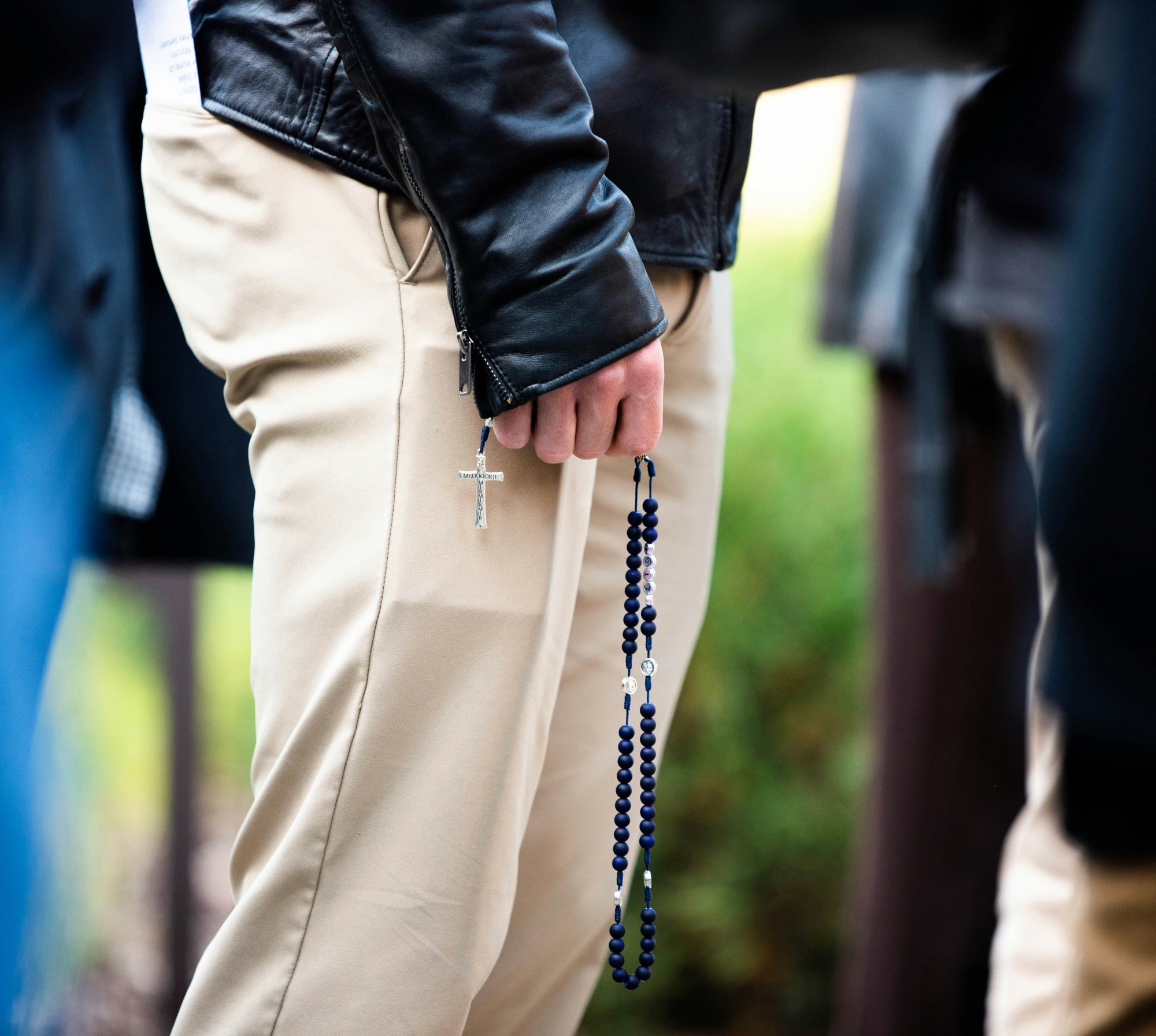
The rosary is essentially a long prayer or meditation dedicated to Mary, the mother of Jesus. Let me assure purists that Catholics do not pray to Mary, we do not worship Mary: we are asking her to intercede for us, that she, the Lord’s mother, might petition on our behalf. So the story goes.
While praying the rosary, we say a prayer affectionately called the “Hail Mary” fifty times, and we count out the prayers on rosary beads. There are five decades, each consisting of ten beads.
So that’s how it’s done. Now, I don’t know if a lot of Catholics would describe the rosary the way I do, but this is the truth: when we’re saying the rosary, a group of us together, we say we’re reciting it, but we’re not really reciting, we’re chanting. There’s a rapid rhythm to it that I myself find comforting. When I’ve invited nonCatholics to join the rosary, I’ve noticed they’ve had a hard time keeping up. We’re all just used to saying it at top speed!—sorry ‘bout that.
I’m not sure, but I suspect that there are those Catholics today who find the rosary not modern enough. It used to be standard to gather at the mortuary the night before a funeral and chant the rosary together for the repose of the soul of the dearly departed. These days, the new tradition I hear is to say only a decade or two while a priest or deacon talks about the mysteries of the rosary.
Don’t worry. I’ll get to the mysteries.
I just want to confess, that as a lapsed Catholic with a bent toward Eastern meditation techniques, I love an old-fashioned rosary chant. This is how my Mom taught me to say it, and the nuns at my elementary school followed suit. They used to have us chant it every morning in May because May is Mary’s month.
Anyway, TMI. Let me get to the mysteries.
When you’re chanting the rosary, just as when you’re doing any type of meditation, your mind has a tendency to wander. That’s where the mysteries of the rosary come in. The mysteries are scenes from the life of Jesus and Mary, all referenced in the New Testament, on which we are encouraged to meditate while chanting the Hail Mary fifty times. A few of the more familiar scenes are the birth of Jesus in the manger, the Crucifixion, and the Resurrection. If you would like to read about the most common mysteries, you may find information here.
The Mysteries of Jesus the Migrant were written and posted over a decade ago on a website staffed by students at the Catholic Theological Union. The author’s name is Brother Maxime Villeneuve. He writes: “I am proposing these mysteries in solidarity with the millions of our brothers and sisters who live in the shadows of our society. . . I pray that they may find solace in the hardships faced by Jesus and the Holy Family, and know that the Lord walks with them.”
These are the mysteries he proposes for our contemplation.
1st Mary, who is in labor, and her husband, Joseph, find no room at the inn.
2nd The flight from Herod’s persecution.
3rd The journey through the desert from Judea into Egypt.
4th The hidden life of the Holy Family in a foreign land.
5th The Son of Man has no place to lay his head.
If you would like to see the biblical references and to read more, please follow this link here.
I find the fourth mystery to be most poignant. The only reference in the Gospel of Luke that I’m aware of is but a few short lines, yet it brings to mind the people who are living here secretly, without documentation, because they were fleeing gang warfare or government repression or poverty, and they wanted something better for their children—at the very least—a sense of safety. My heart goes out to these people—perhaps the parents of my former students. I will whole-heartedly meditate on these mysteries with them in mind.
I read another online article, written by a doctoral student in history who objected to Jesus being referred to as a migrant or refugee. He notes that although the Holy Family were escaping persecution, they did not meet the United Nations definition of refugee since Judea and Egypt were both part of the Roman Empire. No international borders were crossed. His point seems to be that Mary and Jospeh did not break any laws as they sought a safe place for their infant son, and therefore they are blameless. Thus it would be incorrect, perhaps blasphemous, to compare them to undocumented, illegal immigrants.
The kindest thing I can say about this is I think he’s missing the point. Fear is fear, and suffering is suffering, regardless of the circumstances. The desire to create a better life for one’s offspring is universal. This should be easy to understand.
One more thing I need to say: everyone, no matter who they are, where they’re from, and what they’ve done—everyone deserves due process if they are accused of a crime. And no one, no matter how awful a criminal they are, deserves to be imprisoned in a jail where they are abused, tortured, denied the necessities of life like food, water, clothing, bedding, medicine—and dignity. If we, as individuals or as a community, condone what is happening, it changes us. It changes our souls.
If you are a praying person, please pray for our country, for the people who are being deported, and for our own children’s future.
I pray and affirm that we are a generous, courageous people. We work together to create a compassionate place for all of our people, citizens and residents alike. We are gentle with each other. Amen.
Photo by Gianna B on Unsplash


