
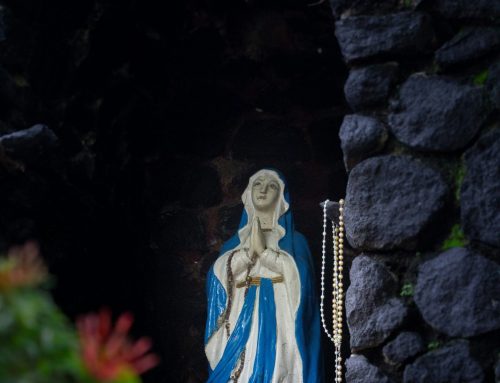
Today is the Feast Day of Our Lady of Guadalupe. As you may know she is one of the many manifestations of Mary, Mother of Jesus, who has deigned to appear to us humans here on Earth. Her story is particularly enchanting.
An Aztec man named Juan Diego, a 16th century convert to Catholicism, met an ethereal woman on a hill. She revealed her true identity and told him to go to the Bishop with a message from her that a church must be built on that very spot.
Of course, the Bishop didn’t believe Juan Diego. This was his role in the story, to be the doubter. He wanted proof.
Juan Diego returned to the hill and Mary appeared again. She told him to gather the flowers growing there and take them to the Bishop. It was winter, when typically flowers do not bloom, but indeed there was a bush covered with blossoms Juan Diego had never seen before. He picked several and gathered them into his cloak to carry to the Bishop.
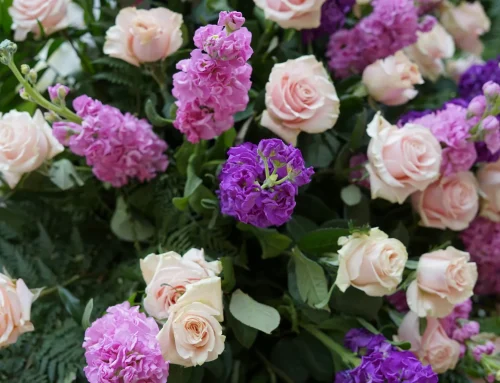
When Juan Diego reached the Bishop’s house, he opened his cloak and the flowers fell out. The Bishop was astounded. The flowers were a variety of Castilian rose which had never grown anywhere except the Bishop’s native Spain. This was the first miracle. When the Bishop looked up, he saw a beautiful portrait of Mary imprinted on Juan Diego’s cloak.
Of course the church was built, many Aztecs were converted, and Juan Diego was canonized a saint.
I love many of these miraculous stories of Catholic saints. They are their own particular genre of magical realism. I do apologize if anyone is offended by this. I am aware that many Catholic missionaries were brutal and indeed murdered indigenous people. Of course I do not condone this. But I still love the stories. I was raised on them, and they are special to me.
My main purpose in writing about Guadalupe is to point out that she falls into the growing tradition of Black Madonnas. Probably the most famous Christian Black Madonna in modern times has been Our Lady of Czestochowa in Poland, an image of Mary said to have miraculous powers. But she’s not the only one. Check out Wikipedia. It has a very long list of of dark skinned Mary’s—and she’s been showing up all over the world.
Just who and what are these Black Madonnas? Essentially they are manifestations of Mary with dark skin. Some in the Catholic hierarchy rationalize that many depictions of Mary have darkened due to devotional candle smoke and soot. Others say Black Madonnas were created from naturally dark woods, and the sculptor apparently gave no consideration for the skin color Mary should or shouldn’t have. And then there are many scholars who theorize that these representations of Jesus’s mother are deliberate attempts to reflect (and perhaps recruit) local populations. But sometimes the local population doesn’t have dark skin themselves. After all, she’s all over—northern Europe too.
It’s possible these Mary’s were co-oped Earth goddesses. I’m fine with that. Even though i was raised Catholic, I’m happy now to worship Divinity as Goddess.
Nonetheless, I don’t know enough to weigh in on the validity of these theories. But I do feel she is the energy we need now. Most people writing about Black Madonnas feel she is a more honest depiction of a Middle Eastern woman, as well as a signal to celebrate diversity in Christian Churches. I love this, but I feel she also represents something deeper. I personally want to move away from the dualistic patterns of male/female, black/white, good/evil, heaven/earth, body/spirit: God embraces all. All. The Black Madonna is a holistic emblem of mystery, shadow, collective consciousness, and magical oversoul. She is all, because black is all. It is all colors combined. All.
Here in the Northern Hemisphere we are moving closer to the winter solstice, deeper and deeper into the darkness, into mystery, into surrender.
Slow down. Take your time. Drink a cup of tea and eat a cookie. Ask for guidance.
The photo is one I took at the beginning of the Women’s March in January 2017.
Leave A Comment